Arbitrum Orbit
Key Takeaways
- Arbitrum Orbit allows developers to easily launch app-specific or general-purpose L3s based on Arbitrum Nitro stack.
1. Overview
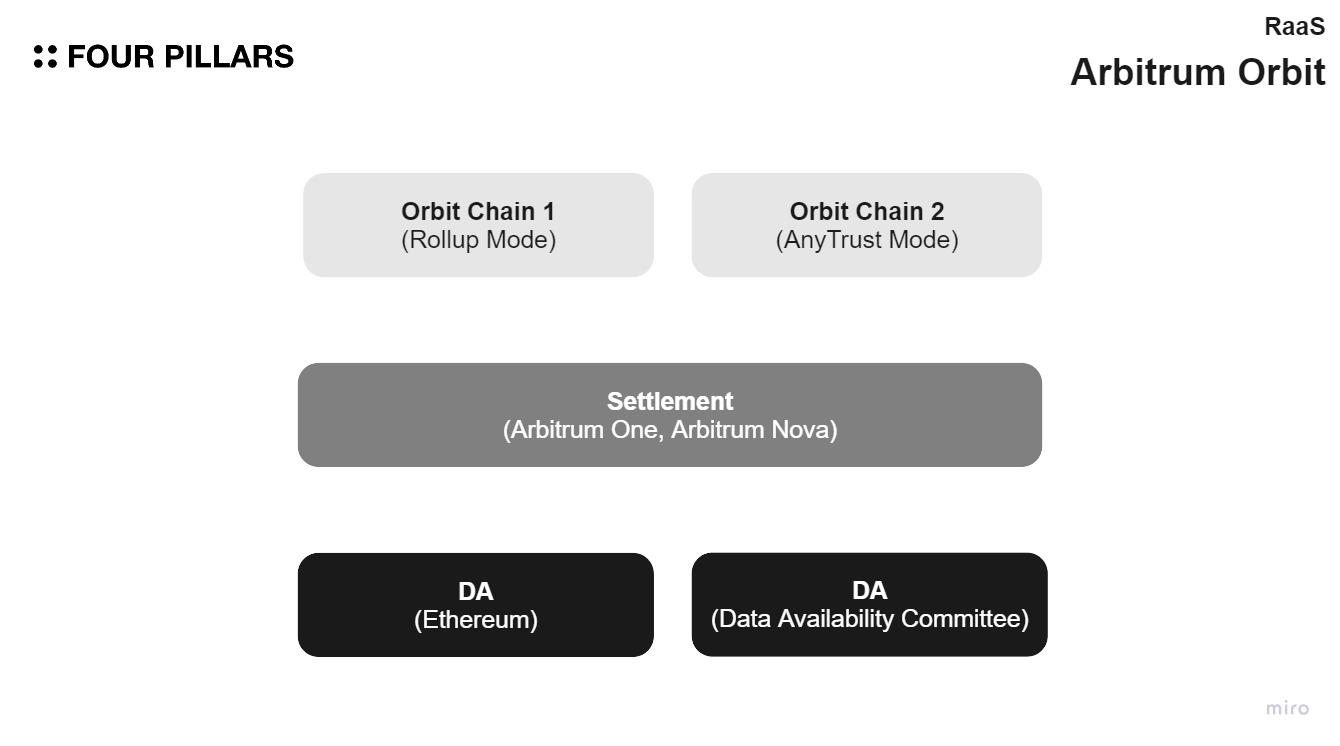
Arbitrum Orbit allows developers to launch app-specific or general-purpose L3s easily. The L3 networks built with Arbitrum Orbit are based on the Arbitrum Nitro stack and can use Arbitrum One or Arbitrum Nova as the settlement layer.
2. Execution
Orbit chains are based on Arbitrum Nitro stack, providing high EVM compatibility. For more details, please refer to ‘Arbitrum One & Nova’ on Modular Odyssey.
3. Settlement
Orbit chains utilize Arbitrum One or Arbitrum Nova as a settlement layer.
4. Data Availability
There are two data availability options for Orbit chains:
- Rollup mode: Orbit chains using rollup mode store transaction data on the Ethereum network.
- AnyTrust mode: Orbit chains using AnyTrust mode utilize Data Availability Committee (DAC) to store transaction data.
For more details, please refer to ‘Arbitrum One & Nova’ on Modular Odyssey.
5. Interoperability
Since all Orbit chains are based on Arbitrum Nitro, they are part of an ecosystem of connected chains that can exchange information. However, interoperability features are now work-in-progress and haven’t been released yet.
6. Customization
Arbitrum Orbit provides various customizing options:
- Permissioned Access: Developers can freely choose which contracts can be deployed on their chain. Permissionless, permissioned, or anything in between is possible.
- Data Availability: Developers can build an Arbitrum Rollup chain that is based on Ethereum, or they can build an Arbitrum Anytrust chain that uses a DAC.
- Customizable Protocol Logic: Developers can modify the logic of chain’s settlement, execution, or governance protocols.
- Customizable Fee Token: Developers can allow chain’s users to use any token other than ETH for the fee token.
7. Use Cases
7.1 AltLayer
AltLayer is a RaaS project that allows for the easy deployment of rollup networks without writing code. One of its main features is creating a Flash Layer, a rollup network that can be used temporarily and disposable when no longer needed. It will roll out support for Orbit by Q3.
8. Team
- Ed Felten (Co-founder)
- Steven Goldfeder (Co-founder)
9. Resources
- Website | Docs | Blog | Twitter
- [KBW related Article] Arbitrum 101 by 100y (Four Pillars)
- Launch an Orbit chain by Arbitrum
